Neurolocalisation and case-based work-up of cranial, spinal and peripheral nervous system lesions

Neurolocalisation and case-based work-up of cranial, spinal and peripheral nervous system lesions

Introduction

This intensive two-day course, Neurolocalisation and Case-Based Work-Up of Cranial, Spinal and Peripheral Nervous System Lesions, offers a practical, highly interactive deep dive into small-animal neurology. It combines concise, targeted lectures with hands-on case discussions to help clinicians sharpen their diagnostic skills and improve everyday clinical decision-making. With no restriction on participant numbers, the programme is designed to be accessible, engaging and immediately applicable in practice.

Course Objectives

  • Strengthen confidence and accuracy in small-animal neurolocalisation.
  • Quickly distinguish central from peripheral vestibular disease.
  • Understand when and how to perform CSF taps, and interpret CSF findings effectively.
  • Work through real cranial, spinal, peripheral and neuromuscular cases using a structured problem-solving approach.
  • Enhance clinical reasoning and streamline neurological work-ups in general practice.

Thomas Flegel (Germany)
Diplomate ACVIM (Neurology), Diplomate ECVN
(Neurology)

Veterinary Training
1986-1992 – Humboldt-University Berlin, Germany

Working Experience
1992-1998 – Working experience in large and small animal medicine in university (Freie University Berlin) as well as in private practice in Berlin
1998-1999 – Department of Companion Animals and Special Species College of Veterinary Medicine, North Carolina State University, USA, Internship in Veterinary Neurology
1999-2001 – Department of Veterinary Clinical Scienes, The Ohio State University, USA, Residency in neurology and neurosurgery
Since November 2002 – Department of Small Animal Medicine, University of Leipzig, Germany, Head of the section of neurology and neurosurgery

Veterinary and Academic Qualifications
1994 – Doctor medicinae veterinariae (summa cum laude)
2001 – Master of Veterinary Sciences (The Ohio State University, USA)
2003 – Diplomate American College of Veterinary Internal Medicine (Neurology)
2005 – Diplomate European College of Veterinary Neurology
2008 – European Specialist in Veterinary Neurology
2010 – Dr. med. vet. habilitatus (small animal surgery and small animal neurology)
2016 – 2018 – President of the European College of Veterinary Neurology

DAY 1

09.00-09.10 – Welcome
09.10-10.30 – Neurolocalisation
10.30-11.00Coffee break
11.00-12.00 – Differentiating between central and peripheral vestibular disease
12.00-13.00 – Talk: CSF tap and CSF analysis
13.00-14.00Lunch break
14.30-16.00 – Interactive case-based workup of cases with cranial pathologies (I)
16.00-16.30Coffee break
16.30-17.15 – Interactive case-based workup of cases with cranial pathologies (II)
17.15-18.00 – Day recap and welcome cocktail

DAY 2

09.00-10.30 – Interactive case-based workup of cases with spinal pathologies (I)
10.30-11.00Coffee break
11.00-13.00 – Interactive case-based workup of cases with spinal pathologies (II)
13.00-14.00Lunch break
14.00-16.00 – Interactive case-based workup of cases with peripheral nervous system pathologies
16.00-16.30Coffee break
16.30-17.30 – Interactive case-based workup of cases with neuromuscular lesions
17.30-18.00Closing remarks

Neurology 1

Neurology 1

HOW TO DESCRIBE WHAT YOU SEE AND KNOW IF IT IS NORMAL

The neurological examination is one of the most important and cost-effective tools in clinical neurology

During this course delegate will learn:

  1. To determine if the nervous system is affected in a disease process (to detect the presence of a neurological abnormality)
  2. To establish an accurate anatomical diagnosis, to localise the lesion (to determine its location)

The neurological examination is the most important step in identifying if a patient’s condition is neurological (versus medical or orthopedic) and where in the nervous system the pathology is located. Delegate will be explained how to establish a routine standard procedure for examining an animal. This will provide the experience and confidence necessary to make an accurate neuroanatomical diagnosis. The neurological examination should enable an anatomical diagnosis to be established and determine where the lesion is: Brain, Spinal cord or Peripheral nerve and muscle. It is important to consider if one lesion can explain all deficits, or if the disease is more diffuse or multifocal.

This course is aimed at the every clinician as well to those with more experience and interest in small animal neurology.

DAY 1

Time Title
09:00 – 09:15 Welcome and Introduction
09:15 – 09:45 Multiple Choice Test
09:45 – 11:00 Talk: Neurological Examination
11:00 – 11:30 Coffee break
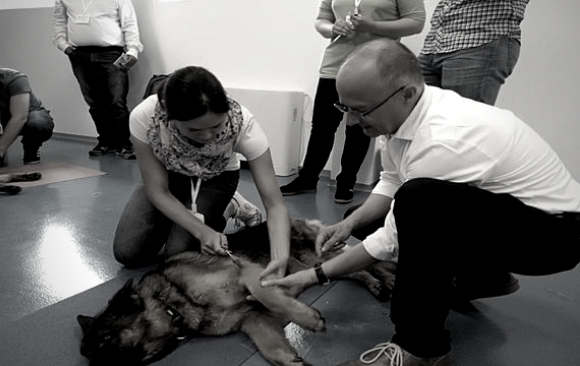
11:30 – 12:00 Demonstration of Neurological examination
12:00 – 13:15 Neurological examination performed by participants
13:15 – 14:15 Lunch
14:15 – 15:45 Talk: Neurolocalisation
15:45 – 16:15 Coffee break
16:15 – 17:45 Neurolocalisation with everybody together based on videos Part I (6 cases)

DAY 2

Time Title
09:00 – 11:00 Neurolocalisation based on videos in groups part II (6 cases)
11:00 – 11:30 Coffee break
11:30 – 13:00 Cases from the first session of the day are presented by the participants to everybody and discussed together
13:00 – 14:00 Lunch
14:00 – 15:45 Neurolocalisations on real patients (if available)
15:45 – 16:15 Coffee break
16:15 – 17:30 Discussion of own cases (every participant has to bring one own case)
17:30 – 18:00 MC-Test to allow the participants to judge the progress they have made during the seminar